

Algorithm IV: Tropes & Comps
Different issue, same outcome

If you have never queried, you may be unfamiliar with the notion of comps—the term refers to other books or works your story may be compared to. In other words, what book(s) should your book be recommended to readers of? The literary world is absolutely obsessed with this notion, because that is how you sell books nowadays: your book is assigned a place within the hierarchy of recommendations, and The Algorithm does the rest. Agents want you to provide comps that are specific and relevant, but not overly ambitious—even though I was explicitly inspired by ASOIAF, if I compare my book series to it, the agent is unlikely to believe me, because that series’s success was once-in-a-lifetime. They want you to do enough research to understand where your book fits within the landscape of book publishing as a whole. As a writer, it is your job to understand the genres, conventions, and tropes of writing that is similar to yours.
I believe that this framework is nothing less than poison to the craft of writing. I would like to explain why, but to do so, I need to talk about how we got here. And that story begins with tropes.
TV Tropes Dot Com
Before tackling this topic, I decided to consult my Norton Anthology of English Literature (7th Edition) for a formal definition of trope. I knew I had encountered the word briefly in high school, more thoroughly in college, and I wanted to start from a place of authority.
I did not find it in the glossary.
Turning next to the OED Online, I found that the contemporary usage, “A significant or recurrent theme, esp. in a literary or cultural context; a motif,” dates from 1975.
That explains a lot.
I think the easiest way to understand tropes is through genre fiction. A trope is a recurring element in fiction1—less profound than an archetype, more prosaic than a motif. It is the lone wanderer in a western, the gothic atmosphere in a horror movie, the dark-haired main love interest in a romantasy tale. It is, essentially, the narrative equivalent of a stock photo.
That may sound a little reductive—but I offer as defense that tropes themselves are reductive, flattening all storytelling into Jenny’s “list of things” that I discussed in Part II of this series. They are also nebulous—the definition of trope, the category itself, has had very fluid boundaries, especially in recent decades, absorbing all of the patterns that audiences recognize across media. For any stock character or scene you observe, you can head over to TVTropes.com and find that someone else has already identified that element and assigned it a neat little label (as I did, when I was comparing TLJ and Empire).
Tropes have, as far as I can tell, become the predominant analytical framework by which audiences engage with narrative. This is a problem because a trope is not, in and of itself, a measure of anything—it’s a way of describing an element of a story, of categorizing repeating elements, with no actual commentary on quality or appropriateness.
If I cooked you a dish and asked you if you liked it, and you responded with, “It’s salty,” that would tell me nothing. Is the dish supposed to be salty? Do you like salty food? Is it too salty or not salty enough? Similarly, if I ask you what you thought of a movie, and you respond that the main character is a Mary Sue, that tells me nothing beyond the fact that you can identify and name narrative patterns.
This is also what makes trope-based analysis so toxic: it ignores the structural components of narrative that necessitate the patterns audiences observe. When you begin writing your own fiction, you discover that there are limited narrative paths available to you, once you make particular choices. Frodo can either throw the ring in Mount Doom or succumb to its influence, leaving someone else to throw the ring in. There is not a world where a story like The Lord of the Rings ends with the ring not being destroyed, Middle Earth falling forever under the reign of Sauron.2 Narrative paths have limited branches, and the variations on those branches are finite.
I do not wish to suggest that tropes are entirely useless; they have limited utility as a critical tool, but not everyone is consuming media through a critical lens. And here I want to proceed carefully, because I feel that I cannot continue without addressing fanfiction. The realm of fanfiction is a fascinating one, and there is a lot tangled up in it—both good and bad—which I do not have time to address in this post. But I cannot ignore it entirely, as fanfiction (and shipping culture, more broadly) is where, I believe, the line between story and audience begins to blur.
Author & Audience
If you have never visited a fanfiction site3, each title in their library comes with a veritable wall of tags—a litany of tropes for you, the user, to select which narratives will contain the precise elements that most appeal to you. If you select a fic and choose to read it, you will have unprecedented access to an aspiring author to give them feedback on the story they are telling. And since many of these stories are serialized, the author will have the ability to mold their story to the majority of feedback they receive, contorting what the story should be, until it becomes whatever audiences want.
And thus I have described the current state of the market for narrative fiction.
I don’t want to blame audiences for this state of affairs—none of this would be possible without an Algorithm that feeds on our neat labels and looks for efficient ways to associate those labels with other labels. The very notion of tagging is us doing The Algorithm’s work for it; it is both enabling and preying upon perfectly natural audience behavior. But I am here because I failed to get my book into the market—I am here because writers are suffering under this model. So while it is not the audience’s fault that we ended up here, it is up to audiences to decide whether they want to celebrate and encourage writers who do not fit into The Algorithm’s neat little boxes.
It is up to you.
Nothing New, Ever
Let me back up a bit, to where I began this post. I was scrolling my writing twitter one night, looking through the posts of other aspiring and newly-published writers—it was a lot of the usual stuff, people tweeting about their published or upcoming books, interspersed with writing questions or advice. Looking at the posts about books, I noticed how heavily they relied on comps—stories were pitched more, it seemed, on their similarity to existing stories than on their own, distinct, merits.
And that was when it hit me: the centrality of comps to the market incentivizes writers to tell endless variations on old stories, rather than writing something new. Nothing new, ever, right? If you’re thinking right now that agents will accept a book without comps (an incomparable book, if you will), well…I don’t fault your naivete, since we established in the first paragraph that you have never queried. I have already addressed in this blog that writers are required to be our own promoters and social media managers—we are required to do the research, to find comps for book agents.4 We are required to understand the market. We are required to write to the market, if we wish to be published. This is how content is produced. But it is not how art is made.
At one point, I considered that I needed to read more fantasy, to find comps—the mere thought was exhausting, as I have a hard time reading, and I don’t like to take too many risks on unknown books.5 But my time reading romantasy showed me there is a danger from only consuming narratives within my own genre: romantasy writers copy each other constantly. They use the same phrases, the same scenes, the same aesthetics; so many of these writers make a “list of things” the foundation of their book, then write the exact same scenes in only a slightly different way (or, more often, the same way6). They are not influenced by anything outside their genre, and it shows in their writing.
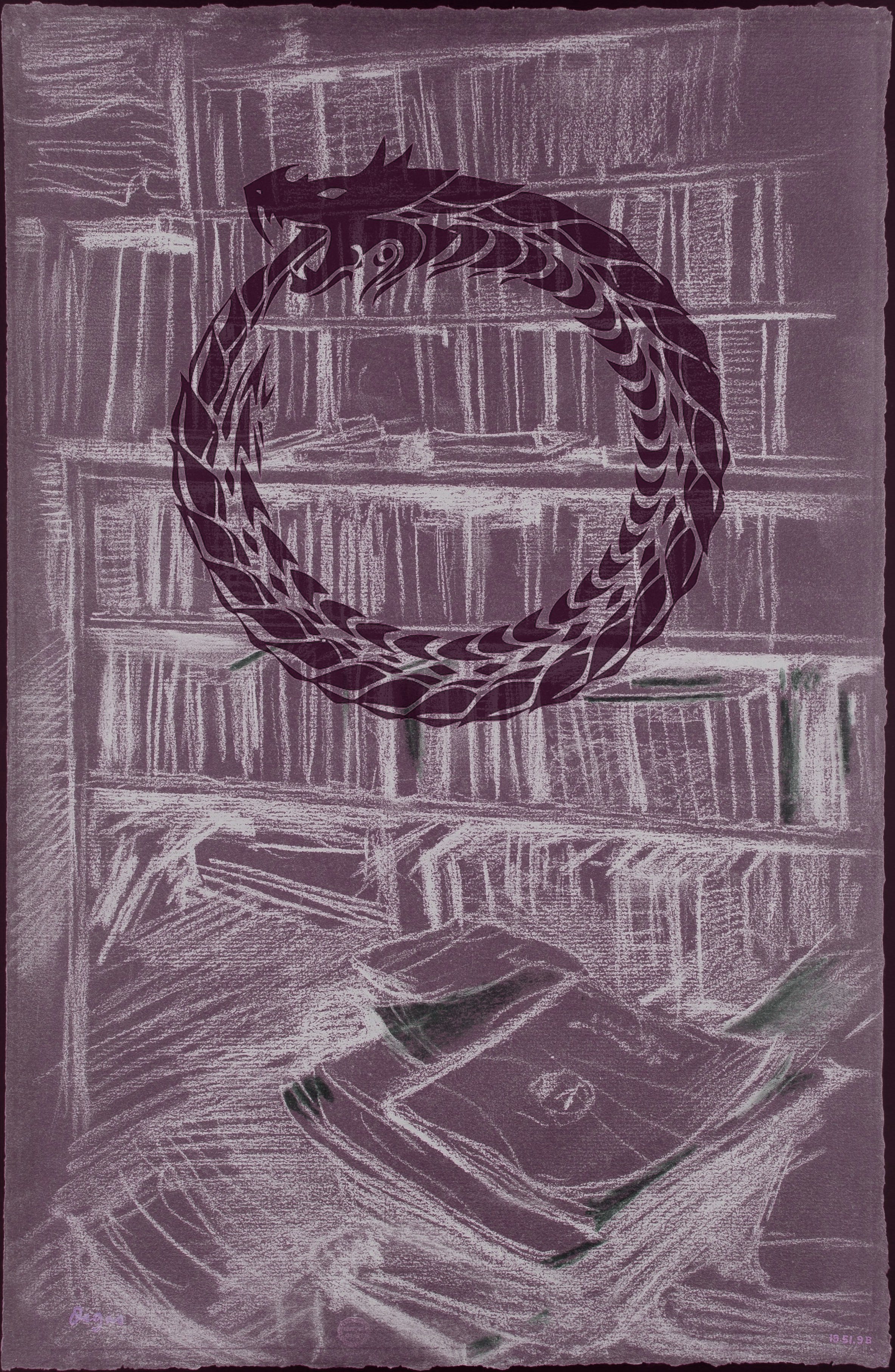
This is where the ourobouros comes full circle. Imagine you are an aspiring author, and you read a bunch of fantasy, and you decide you want to write a fanfiction for your favorite ship. You take your list of tropes and cobble them together, removing logical elements, like the backstory that has shaped the characters in your ship, and replacing them with whichever trope you prefer (or hand-wave the parts that don’t interest you or don’t have an associated trope, which is another huge weakness in romantasy writing). Fanfiction can ABSOLUTELY produce original stories, if the authors use the original story as merely a jumping-off point, and follow the new story down whatever paths it suggests. But the more tropes you pull from existing media, the more constraints you place on that new story, until you are producing a patchwork of other people’s writing.
In my last Algorithm post, I closed with a scene from Across the Spider-Verse, which I consider to be the height of artistic achievement. The principle I articulated there, that new stories are being choked out of media altogether, also applies here: replace nostalgia with trope, and you get these patchwork narratives, adding nothing to the narrative ecosystem and reproducing the most popular memes within a given genre. The result is a corpus of the same tropes, served in slightly different forms. The result is Algorithmic slop.
And soon, it will be AI slop. But that’s next week’s post, the final post in this series.
People have also used the term to describe non-diegetic aspects of media, such as the token Ken Burns effect in documentary filmmaking…and this scope creep is part of the problem.
As we have exhausted the potential paths of the most common narratives, storytelling has, in fact, branched out into this sort of narrative—one of my favorite fantasy series actually ends with the protagonist failing to save her world, which is a commentary in and of itself. But I think we can all agree that, given the time it was written and the nature of the story, the Lord of the Rings was always going to end with its heroes triumphant.
I have only done this once, about 8 years ago. But I have engaged in spaces where authors are tremendously online, and I think the pattern I articulate here is broadly true, and applicable to any forum (platform) where junior writers are sharing their work (including critique sites—which I have witnessed).
Indeed, one of the main pieces of advice I have seen from agents is that we need to provide solid, relatable, realistic comps. None of this is inference; it is all direct observation from my time querying.
Reading is important, and I will talk about this more in another post. It is worth the struggle. I just can’t do as much of it as I would like.
This is a reminder that, while it is okay to tell an old story in a new way—what matters is how you tell a story—, what you consume also influences that how. I cannot stress enough how much the writers I am comfortable calling out just copy each other—down to individual word choice.