

Trilogic
Write it, cut it, paste it, save it, load it, check it--quick, REWRITE IT.

I imagine it’s quite hard to pants a standalone fantasy novel. I don’t know, because I have never succeeded (though I certainly tried, with my second and third series). It’s the nature of the process—as the story reveals new threads, you want to pursue them, building the lore and the world out alongside them (until you’re writing lore books wholly unrelated to your story instead of finishing The Winds of Winter). An entire fantasy series is one story; sure, there are arcs within that story, side quests and subplots—but it is still just one story.
In 2001, when the credits first rolled on Frodo and Sam entering Emyn Muil, viewers who had not read The Lord of the Rings were shocked—because the story seemed to just…stop. I had a similar experience reading The Fellowship of the Ring, some months prior; it was the first book I had read that made almost no attempt to wrap up threads before transitioning to the next installment. It’s abrupt. But I actually want to talk about what comes next: the structural similarities I have noticed between middle installments of vastly different trilogies.
The Chamber of Secrets Strikes Back
When I was in middle school, two fantasy series absolutely dominated my consciousness: Harry Potter and Star Wars. It is important, I think, to remember where these two series were at the time I encountered them: Harry Potter was a trilogy—there were more books coming, but only three existed when I came to it.1 My relationship to Star Wars, on the other hand, was quite tangled: I had watched the original movies, then deleted them from my brain upon seeing the image of Luke’s face in Vader’s shattered helmet. The first Star Wars movie I watched and loved was The Phantom Menace—my love for that brought me back to the original trilogy.

But I still hated The Empire Strikes Back. It was strange, and scary—and deeply unsatisfying, as it begins in the middle of an adventure I was not privy to, and ends in the lead-up to the next adventure, when the characters are at a low point in their journey. I much preferred Return of the Jedi, which delivers victory after victory, as the heroes systematically defeat every enemy that has plagued them for three movies.
Frustratingly, everyone I talked to seemed to love Empire—it was their favorite Star Wars movie, much like Chamber of Secrets seemed to be everyone’s favorite Harry Potter book. What was going on? What was wrong with me? Why didn’t I enjoy the episodes that everyone else seemed to love?
Trilogic
I have actually read the entire Harry Potter series enough times to consider this question thoroughly, and come to an answer.
Disclaimer: This post does not constitute an endorsement of anything the author of the books mentioned herein has ever said outside of the pages of the seven books that constitute the original series (or even an endorsement of everything said within the series—but that, as usual, is a whole other post).
Harry Potter and the Chamber of Secrets is quite a funny book. Of the many Defense Against the Dark Arts professors Hogwarts is subjected to during Harry’s education, Gilderoy Lockhart has the distinction of existing purely as comic relief. Moreover, this comic relief yields double value when moving up in grade positions Harry to be an ironic foil for Lockhart—the reluctant hero versus the pompous pretender. Even on a surface level, the more direct involvement of the Weasleys with the central story brings Fred and George, the series’s dedicated comic relief, into more visible roles, as well as Ginny, whose crush on Harry is played for comedy. Add to that the misadventures resulting from Ron’s broken wand, which contribute to the humor.
But Harry Potter and the Chamber of Secrets is also an odd book, with regard to the main plot of the series: Harry versus Voldemort, friendship versus followers, love versus death. The antagonist of the story is an echo of Voldemort past—one that is only revealed to impact the main plot in the last two books. So by the time we realize the stakes of Chamber’s climax, it has already happened. As part of a trilogy, Chamber mostly serves to affirm Harry’s hero qualities, and to allow him explicitly to reject the characteristics he shares with his chief enemy.
I think that last bit is important, because it parallels Luke’s main plot in Empire—The Empire Strikes Back is, essentially, a walkabout. The protagonist abandons the main quest to find his power and reject the villainy within himself, before he confronts the manifestation of that villainy.
I would like to write a separate post about walkabouts, I think—but suffice to say here that I do not care for them. I actually don’t need to see a hero confront their own capacity for evil; I understand that they reject evil from the structural particularities of being the hero. This is a little black-and-white on my part—I do understand that showing that progression makes for a good story—, but it’s not even my main reason for disliking walkabouts: they’re…boring. I like an ensemble; taking the protagonist away from the ensemble reduces the screen time of the ensemble. It reduces the amount of time we spend watching relationships grow and change, which is kind of my favorite part of narrative fiction. And I already know how the protagonist’s detour will end—again, because they’re the hero.
But this isn’t, as I said, just about walkabouts—it’s about middle episodes, and there is another aspect of middle episodes that I wish to focus on: they tend to be incomplete. Luke’s journey of self-discovery doesn’t end within the run time of Empire—not until we see him emerge, self-actualized, in Return of the Jedi, does that arc resolve2. In fact, all of the arcs begun in Empire are resolved in Jedi. And all of the arcs resolved in Empire are begun in A New Hope. There is not one complete, whole, satisfying, story arc in The Empire Strikes Back. Is this a problem? I think…no? But it explains my dissatisfaction: Empire feels incomplete because it is! The movie is, literally, the middle—it is the thing that bridges the beginning and the end. It’s a fine movie, but it is only part of a whole story.
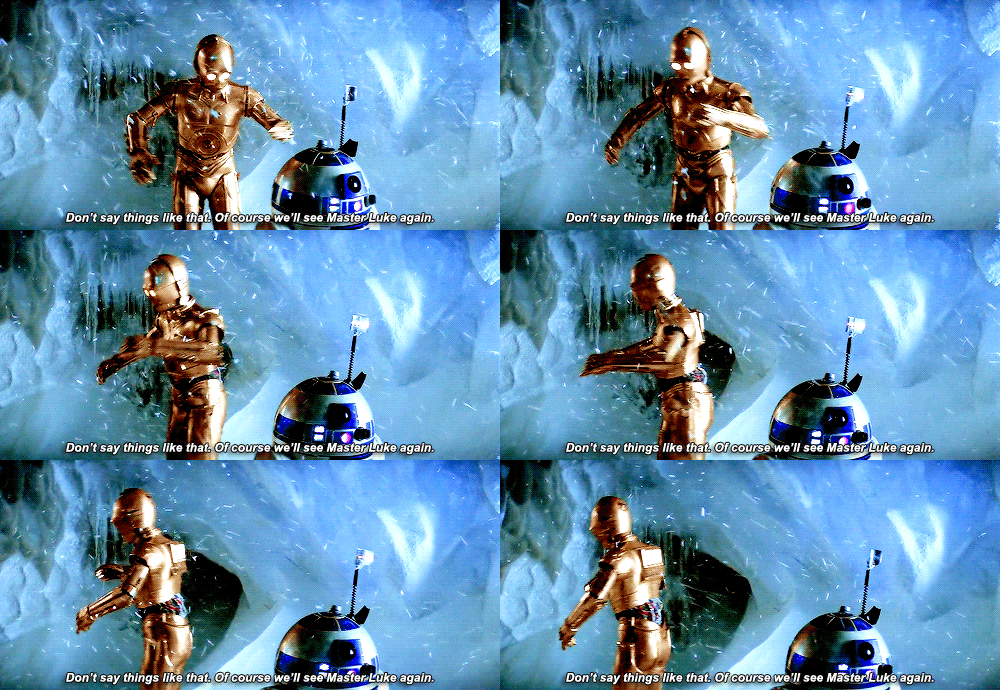
So why does everybody else love middles? I have an answer for this, as well: the stakes are lower. Like I said, Chamber of Secrets is a funny book. Similarly, Empire has a lot more quippy dialogue than its counterparts—mostly as part of the romance plot, which there is actually time to flesh out. In addition, Senile Yoda brings a measure of comic relief, as does the first iteration of Dismembered Threepio3. There is more time for comedy because no one story needs to be resolved before the middle episode concludes.
Now seems a good time to note that both of these stories also include some of the darkest moments of their trilogies. Not only are the protagonists tortured by the parts of themselves they share with their villains, but both stories include the capture of a found-family member by that villain. Comic relief is perhaps more warranted: while both of these works are part of generally-humorous series, an increased dose of humor seems to offset the darker elements that are being explored. For many audiences, I think both the humor and the darkness make these installments stand out among the narrative arcs of trilogies. For me, the humor is enjoyable, the darkness is a bummer, and I just want everyone to be in one place again4.
The Side Quest of the King
After high school and during college, I worked a couple summers at Talbots. I often worked closing shifts, 2-10pm, so by the time I got home, there wasn’t time to do much before bed (I had not yet blossomed into a full night owl)—certainly, there was not time to watch all of The Lord of the Rings (extended editions, naturally). So I would put on The Two Towers, to wind down. It became a kind of rule with me and my mom: if we didn’t have time for the whole trilogy, we would watch The Two Towers.
The Two Towers is very much a middle. It’s the most middle—I used it as my opening example for this very reason! You have the dual walkabouts of Frodo being carted (unnecessarily) to Osgiliath, and Aragorn et al. being pulled into the travails of Rohan, after finishing their quest to rescue Merry and Pippin. As Faramir confronts the darkness in the hearts of men, Legolas and Gimli up the level of comic relief through their competitive orc-slaughter (and Andy Serkis does both—yielding for a time to the much lighter persona of Smeagol, who literally confronts the darkness that is Gollum). Aragorn straight-up goes missing and walkabouts his way right into a dream sequence (read: obligatory Liv Tyler appearance).
So what makes it different? I think it is useful, here, to look at the movie as, simply, Aragorn’s walkabout—and, by extension, the walkabout of man as a race within Middle Earth, to find the parts of themselves that are still worth saving from Sauron. Faramir’s subplot may be happening on the other side of their world, but it is thematically linked; Faramir himself is a synecdoche for the corruptibility of man as a whole. That corruptibility is central to Aragorn’s journey throughout the series, so it is every bit as important as the struggle Aragorn is directly involved with.
Rohan and the Battle for Helm’s Deep, too, is a compelling singular narrative—a prelude for the War for Middle Earth, which will end with the reign of man. The side quest of the series is the main quest of the film, making it a self-contained episode within the larger story—even though it is by no means self-contained on any deeper thematic or symbolic level. Sure, the arc of Theoden is not resolved until Return of the King, and the arc of getting the ring to Mount Doom began in Fellowship—but the arcs of saving Rohan, defeating Saruman5, and attempting to redeem Gollum are all wrapped up within the run time of one movie (Smeagol failed his walkabout).
Nor is it entirely a side quest: the battle for Rohan, like the battle within Faramir, is a part of Aragorn’s journey as a whole. In his plot to embrace his role as king, he has been on a walkabout since before the first movie, and Helm’s Deep is the final step to prepare him for his destiny. By emboldening Theoden to reject the weakness within himself—the failure that has already brought destruction upon his kingdom—, Aragorn helps to engineer the final proof that he, too, can assume the mantle of king, without fearing his own darkness. His own confrontation will not occur until the next film, but this prelude is an essential one, priming Aragorn to complete his core arc within the span of an already crowded finale.
Advice?
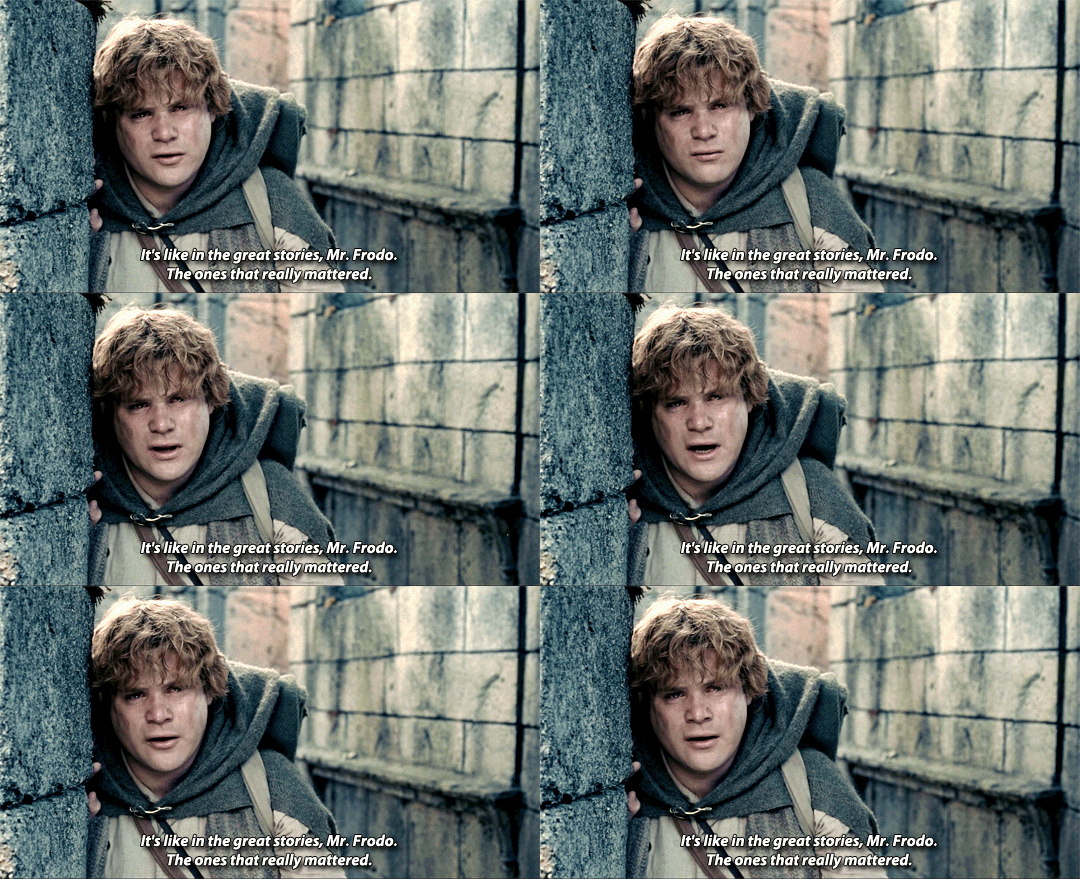
So is The Two Towers better than The Empire Strikes Back? Of course it is! Bypassing that one is a loving adaptation of a rich allegory set against the backdrop of a compelling world with fully-realized lore, and the other is Archetypes…IN SPACE! (directed by a man who notoriously undervalues the craft of acting)—setting those things aside, I would argue, purely on story strength, that The Two Towers is better for its internal cohesion. The movie is explicitly aware of the threads that remain unresolved at the end—but they are tucked under the absolutely heart-wrenching final beats of the film, from the high highs of Sam’s speech about darkness passing to the low lows of Grima’s final, redemptive act.
I keep telling people that this is a writing blog, so I should probably conclude with some writing advice—and I am prepared! If you are writing a series, it is not enough to arbitrarily break your books up along lines of word count or diegetic time. Well, it is enough, clearly, given the success of Star Wars—but you can serve yourself and your audience better by putting some thought into how each installment of your series works as a standalone novel.
And if, like me, you are purely making up the story as you go along, you should do what I do: as you start to feel yourself hitting book length on the first entry, it is worth taking an evening to have a think about where your story is going, and how you can segment it along lines of theme or character. Again, you don’t have to do this, but it will make your story stronger, reinforcing the smaller arcs that make up your narrative as a whole.
Not for nothing, but this is how serial TV shows work: almost any (good) show6 will find an individual story to tell within the span of an episode, while telling the larger story throughout the season. If you need a specific example, Mad Men season 1, episode 6, “Babylon”, is a masterclass in theming (if you need a second example, I could write 500 or so words about the Right Guard pitch in the show’s second episode, “Ladies Room”).
And if you have no deeper levels to organize individual books around—nothing deeper weaving through your series, underpinning the plot or giving weight to the world—, then you better have a hell of a world, because the trajectory of Star Wars has shown us that surface details can only carry your story so far.
But that’s the Friday post. 😁
I was actually surprised, looking at the publication history, to see that the books were released pretty regularly over the course of its run. I don’t know why I believed the first three books existed for a significant period as a trilogy—but that’s how they were presented to me, and it has shaped how I viewed them since.
You could even argue that it’s not resolved until the climax of Jedi, but I don’t have time to disentangle those threads in this post.
I don’t care for Senile Yoda—I think the concept is good, but the writing is a bit much. I will note, however, that these were both wells that Star Wars would return to, but Dismembered Threepio in Attack of the Clones doesn’t seem to inspire nearly the level of hate received by Senile Luke and WE DO NOT HAVE TIME.
Harry is not physically separated from his friends, but he is separated emotionally, as he retreats into agonizing over his connection to Slytherin. I feel a similar distaste towards the parts of Goblet of Fire and Deathly Hallows that are sans Ron—notably, Order of the Phoenix is exempted because Harry keeps spilling his angst on everyone else.
I know, I know—the books. But I believe this was a change for the better, for this very reason: Return of the King is all climaces, and it would be so lame to follow up all of those bangers with a ruined Shire and a whole other plot.
Alias is the exception here—and a strange one, given that it had discreet story arcs! But it would begin each episode in the middle of one story and end the same episode in the middle of next story. It was lazy, and gimmicky, and disjointed—it contributed little to the story besides the cheap tension of a reliable cliffhanger.