

Right Book, Wrong Time
Sometimes you're not ready for a story.

I have seen Casablanca five times in a theater—the only movies I’ve seen more in a theater are The Lion King, Mulan, and Anastasia. I love Casablanca; for a while, I even claimed it as my favorite movie (pre-1968). I have a favorite line read: when Rick looks at the dossier on himself and quips, “Are my eyes really brown?” I cry every time the band plays “La Marseillaise”.
It took me a few viewings to get there. The first time I saw it, I absorbed nothing but the tragedy of the story. The second time, I was haunted by Rick’s bitterness (although not yet ready to examine it). After the third time, I finally understood the sexual subtext, which is very much buried beneath the Production Code. The fourth time, I appreciated how funny the dialogue is. The fifth time, I developed opinions about the cinematography.
The sixth time I watched it (not in a theater), I gave the film a score of 9.8, docking fractions of points for environmental details. I had finally gotten Casablanca.
All of these viewings happened over a long period, during which I was growing through my teenage and college years, learning about the world that was and the world that had been. Looking back, I can see my first viewing for what it was: I was too naive to appreciate the depth of Casablanca.1 This has happened to me a number of times: in this post, I would like to examine a few representative cases, with a few different outcomes, of stories that I encountered when I was not ready for them.
Reading Above My Level
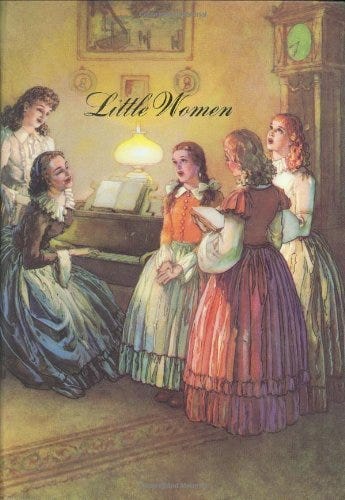
My elementary school had a program that rewarded points based on the books students read (and took quizzes on, to prove we actually read them). Overachiever that I was, naturally I looked at the list and picked the most points-heavy books for my reading list. I was in fourth grade when I read Little Women. In sixth grade, it was Gone with the Wind. Both books were absolutely foundational to my childhood sensibilities.
In fifth grade, however, I read Ivanhoe.2 I regret this—doubly so that, unfortunately, I have not had the energy since to revisit it. Since my reading time was the hour before bed, my first issue was that I found it inconvenient: neither the copious end notes nor the unfamiliar vocabulary (words I felt obliged to write down, so I could look them up later, as I did not want to take a dictionary with me to bed) were conducive to the mindset of pre-sleep relaxation.
Worse, I understood almost none of what was happening in the book. Neither the racial nor the religious tensions echoed anything I had encountered in my young life, and their centrality to the story left me baffled. The complexity of the romance plot, too, was well beyond my ken. I was, simply, too young for Ivanhoe—and I resented the book for years, believing that it had done me wrong by being unintelligible, where other classics I had read were still accessible to me.
Shocked Into Submission
When I was in sixth grade, my mother attempted to get me out of a reading assignment. I did not like scary things, you see, and one of the books we were to read that semester was Agatha Christie’s And Then There Were None3. We started this study by reading the poem at the beginning:
Ten little Indian boys went out to dine;
One choked his little self and then there were nine.
Nine little Indian boys sat up very late;
One overslept himself and then there were eight.
Eight little Indian boys traveling in Devon;
One said he'd stay there and then there were seven.
Seven little Indian boys chopping up sticks;
One chopped himself in halves and then there were six.
Six little Indian boys playing with a hive;
A bumblebee stung one of them and then there were five.
Five little Indian boys going in for law;
One got in Chancery and then there were four.
Four little Indian boys going out to sea;
A red herring swallowed one and then there were three.
Three little Indian boys walking in the zoo;
A big bear hugged one and then there were two.
Two little Indian boys sitting in the sun;
One got all frizzled up and then there was one.
One little Indian boy left all alone;
He went and hanged himself and then there were none.—Agatha Christie, And Then There Were None
I was not having it. I went home, showed the poem to my mother, and got her to write a note…which my teacher rejected. I was forced to read the book.
And…I loved it. I read ahead—under the table, with one of my friends, during other classes. I asked to read my favorite chapter aloud (everybody took turns reading chapters aloud). I had a favorite character (Vera). I had a ship (I absolutely do not remember, but Vera must’ve been half of it). I was enthralled.
I will note here that this was not, necessarily, a book I wasn’t ready for—not in the same way as Ivanhoe, where I lacked the tools to understand everything the author wished to convey. But it’s certainly a book I thought I wasn’t ready for, which I suspect comes to the same thing. We don’t always know going into a story what the story will be, and I think it is a mistake to be too discriminating based on what we think it will be. Sometimes the story you’re wary of is actually the exact one you need to expand your palate and open your mind.
A Study in Meaning
I did not quite learn that lesson, however, as I had a similar experience in college. I believe I mentioned in a previous post that one of my college film classes devoted an entire semester to the genre of horror. I was horrified simply reviewing the syllabus: I knew my experience with scary stories, and I was not looking forward to a whole semester of fear.
One of the movies we watched in class (on an actual silver screen4, I’ll have you know) was Roman Polanski’s Repulsion—a movie which scared the ever-loving sh** out of me.
This was not my first encounter with Polanski’s work: I had seen Chinatown in the theater5 some years prior, and it was another story I had not yet learned to love. If I had doubts about the psyche of the director after Chinatown, I needed no convincing after Repulsion: I was dealing with a completely warped morality6. The movie stuck in my head like a thorn, terrifying me and whispering to me; by the time I needed a topic for my final paper, there was no other option.
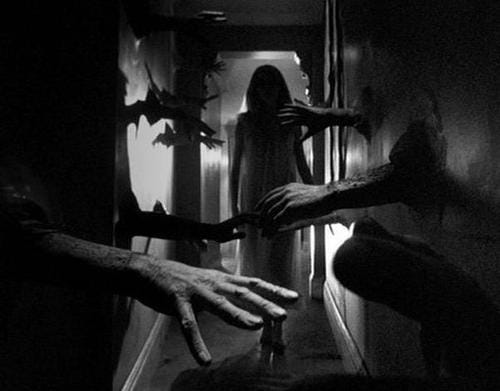
You see, I had grown. I had read stories that made me uncomfortable, seen movies that haunted me. I had studied multiple books in school that I did not connect with as stories—only through studying them in an academic context did I appreciate the depth of their plots, the resonance of their themes. I threw myself into Repulsion, forcing myself to rewatch scenes that made me uncomfortable, to examine them critically. And in the end…I loved the movie. I still talk about it all the time. Turning and facing the text, trying to understand it, made me less afraid and more curious, and the result of that curiosity was valuable enough to make it worth the fear.
Girl, Understood
The best example of this, in the whole of my experience, is Susanna Kaysen’s Girl, Interrupted.
When I was growing up, I was limited in which movies I was allowed to watch—but not which books I was allowed to read, offering me a workaround for several cultural touchstones of my early teen years. Thus I was fourteen years old when I read, in succession, White Oleander, The Hours, and Girl, Interrupted.
All of these books had a profound impact on me, but I don’t think any other story has resonated with me as deeply—as personally—as Girl, Interrupted. Not, as you may guess (from the trajectory of this post), at first—at first, I simply enjoyed the book immensely, while understanding very little of it. After all, I had no experience with BPD, psychiatric wards, or acid (and only superficial awareness of Kandinsky).
Through the subsequent years, however, Kaysen’s words stayed in my mind, gaining new meanings as I matured. My experiences of disorder accumulated as I passed through puberty and into adulthood—and I began to understand more of Kaysen’s experience. My prescriptions changed, which complicated my college experience—and I began to ask myself the questions Kaysen had posed. I started to search for an identity in adulthood—and I began to understand the book I had read a decade earlier. Was I crazy? Or was I just a girl…interrupted?
“Have you ever confused a dream with life? Or stolen something when you have the cash? Have you ever been blue? Or thought your train moving while sitting still? Maybe I was just crazy. Maybe it was the 60's. Or maybe I was just a girl... interrupted.”
—Susanna Kaysen, Girl, Interrupted
Unlike my other examples, this is a book I was not ready for…but which I needed to read when I did, so its story could grow with me. The power of stories is not always in consuming them—sometimes that power is only realized when we carry them with us, allowing them to inform our experiences and enhance our understanding of the world around us. Just because a story does not resonate with me at first does not mean it will never resonate with me, if I am only open to its message.
Wrapping Up
There are actually so many books and movies in this category that I could go on for quite a while (or simply pontificate about Killers of the Flower Moon, a story that won’t stop being relevant to everything I think about). By contrast, Ivanhoe remains the only story I regret encountering before I was ready—and that was a failure of comprehension, rather than understanding.
I will close, then, with this tweet, which is what prompted me to finish a post I conceived months ago (instead of writing the post I promised last week).
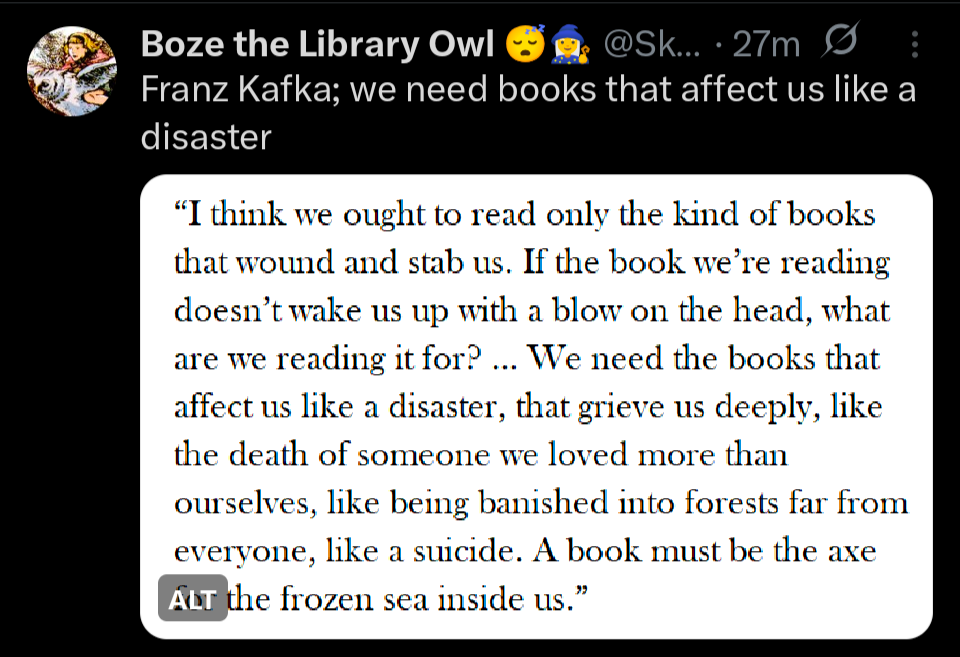
I cannot say it better than Kafka, I think—but that won’t stop me trying—: discomfort should never, in itself, dissuade you from engaging with a narrative. Maturity is uncomfortable. Growth is uncomfortable. Insight is uncomfortable. Truth is uncomfortable. Gaining these things is worth a little discomfort…and missing out on them is not worth the relative comfort of ignorance.
Some of this also has to do with the way I consume stories (particularly on screen)…but that’s another post. Suffice to say that it takes multiple viewings for me to piece together all of the elements of a narrative.
I believe I was also inspired by the second book in my then-favorite series: Knight’s Castle, by Edward Eager. If you have or know a young reader who enjoys magic—or if you are, yourself, a young reader at heart—, I highly recommend Eager’s criminally underrated Tales of Magic series.
I was already going to put a note here about the use of Indians as a racial identifier—then I found out about the publication history. 😬 I had no idea.
Rice had a movie theater on campus, so a number of my classes were held there.
A retro theater in my hometown showed old movies every summer, all summer.
Look, you can’t judge an artist’s personal moral character solely by their work—and, in Polanski’s case, you don’t have to!