

Problems of Scale

Picture a crowd of hundreds of students. Perhaps you can imagine your own high school (I cannot, because we had fewer than two-hundred students), or even your college (I can, because we had twelve-hundred undergrads). How many people are in that crowd? Probably several hundred—and, if you’re following the agreed-upon definition of several, that’s three hundred, minimum.
There are two-hundred-and-eighty students at Hogwarts. How do I know? Five four-posters times two genders1 times seven years times four houses…equals two-hundred-and-eighty. How do I know that the number of students in Gryffindor (where the four-poster beds are described) is representative? Because we were taken through the full Sorting Ceremony for Harry’s year, and we know most of the students by name. Because we are taken through another partial ceremony later. Because we know class sizes and class schedules. And, most of all, because we can observe that JKR has, chronically, a problem with scale.
If you’ve watched a British royal drama (movie or show), you probably can imagine it would be difficult for an eleven-foot-tall man to navigate the halls of an English castle. If you’ve actually seen a person with gigantism, you know that their proportions don’t scale in such a way that requires their handkerchiefs to be the size of tablecloths. And the relative scarcity of Hogwarts bathrooms has already been documented into canon (although I think about it as little as possible, because it makes me too mad).2
Problems of scale are, in my observation, one of the biggest problems in fantasy fiction. The Harry Potter series is a good example because it shows how these problems can range from individual words (hundreds of students) to details (everything about Hagrid) to world-breaking lore (the assumption that nobody in the Wizarding World needs to know basic math, to name one of the least-offensive instances). Rowling’s books evince no attempt to reconcile the Wizarding World with the actual, real world in which it is ostensibly contained.
I have mentioned before how these books influenced my views on storytelling from an early age—and once I saw the problems of scale, I could not stop seeing them. Even when a story’s setting does not interact with our world, problems of scale emerge as weaknesses in the internal logic of the story. I am supposed to believe that Tattooine is a nowhere planet, despite the fact that it appears in every story worth telling from a galaxy far, far away. The “Murder College”3 of Fourth Wing somehow has graduates when senseless murder is permissible—even encouraged. Vesemir is a benevolent father figure who tortures every orphan who comes under his care.
Rather than go on naming examples, I would like to discuss how I have encountered this problem in my own writing—and thereby, perhaps, to provide some guidance as to how you may avoid this problem, if you are also a writer of fiction.
What Is a Problem of Scale?
I actually want to define this term carefully, because I do not think of problems of scale merely as continuity errors involving numbers. A problem of scale occurs when a writer includes a story element that is larger-than-life, but they fail to scale the attendant considerations of that element, to match the augmentation. I have no problem with Hagrid being eleven-feet-tall; my problem is with him still navigating the halls of Hogwarts and living in a cottage where everything is oddly proportioned relative to him.
But this is not the only way a writer may encounter a problem of scale. We, as writers, are given to hyperbole: we often fall into the trap of using size to communicate other forms of excess. Barney Stinson is a lothario because he has slept with hundreds of women4. The Doctor is wise because he has lived hundreds of lifetimes. Voldemort is evil because he has killed hundreds of people. As writers, we may not always stop to think about what it actually means to have sex with hundreds of women or to kill hundreds of people. We do not think about what it would feel like to live scores of lifetimes.
I am, however, going to leave aside those two topics—the problems of scale in moral questions and the problems of scale in immortals—for two other posts, which will hopefully follow this one. For now, we will stick to that definition, taking a problem of scale as a failure to literally scale an aspect of a story.
The Size of a Continent
In my first book series, I have two kingdoms, a “continent” and an island. If you’re picturing Britain and Europe, well…so was I, I suppose, until I sat down and examined it. I had written two full books before I realized that I needed to work out some geographic details of my world, because my characters were about to journey across the island, and they were to do so on horseback. At the same time, I had begun constructing some history for the world, which involved journeys by historical characters across the continent.
Below is the chart that I use for all of my travel times. Stretching this chart to its limits (and adding a dash of magic), I ended up with a “continent” that is the size of France.
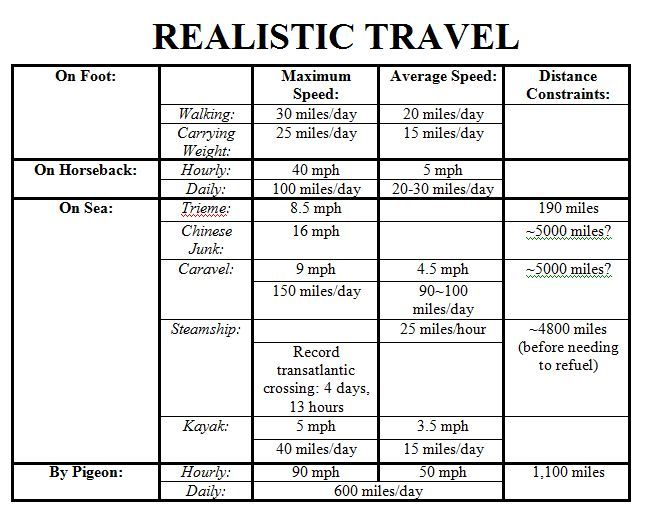
France.
FRANCE.
My world is smol.
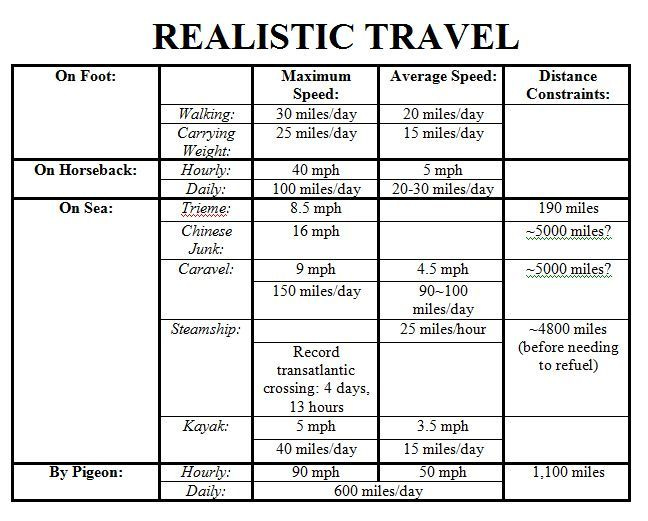
Could I have avoided this by doing some worldbuilding in advance? Perhaps. But you know, by now, how I write. Moreover, I toss world details and lore very casually into my stories, and I find them impossible to track later (and if you have an idea about how to flag small snippets of text in your writing, I would LOVE to hear it). By the time I discovered the maximum size of my landmasses, I had integrated them too thoroughly into the story to go and find every instance and change it to match a larger world. Since this devastating discovery, I have gotten a little better about notating my world details as I casually toss them off, so I will not again be forced to commit to an ill-conceived choice.
The Longest Building in the World
Okay, so I learned something. In the third book, the characters travel to a port city set along the curve of a large bay, enclosed by two massive gates that are also giant buildings. The gate-buildings swing open and closed to admit ships into the port.
Now, several issues with this setup may occur to you immediately: two massive, floating buildings that swing open and closed regularly sound like a logistical nightmare in our world (not to mention the horror for anyone with an inner ear problem). I would address these, of course—but first, I needed to know whether two buildings could be constructed of sufficient size to serve as gates for a reasonably-large bay.
I spent four hours researching this. First, I needed to know the linear distance between the two ends of a curved bay. The Internet was eager to tell me the square footage of various bays in the world, but it was harder for me to figure out what even to call that linear span…until I remembered that one of the most famous bays in my own country was spanned by a rather famous bridge. Comparing the documented length of the bridge with its proportions over water versus land, I concluded that each of my buildings could be half-a-mile long.

One half of one mile is a rather large distance. I knew, from previous research, how far the human eye can see—but I also knew, from personal experiments conducted while driving, that the maximum distance I can hold in my mind’s eye is about a quarter of a mile.
This is important, because it speaks to why problems of scale are, in fact, problems. They are not just errors made by the writer; they become issues for the reader when they exceed the limits of a reader’s imagination. I can describe a building as being a half-mile long—but how is my reader supposed to picture that in their mind’s eye? It is easy, when you are writing, to let the words flow and lose regard for what they actually mean; problems of scale occur when you forget that you are providing images (sounds, smells, sensations) for a reader’s imagination to render. To put it another way, they occur when you forget to picture the things you are describing.
The rest of my research time was spent looking at images of the world’s longest buildings, until I found a reference photo that suited my purposes. It’s not perfect—the buildings are just too big—, but it was enough for me to construct a more vivid image for my readers. And now, when I am trying to create something fantastical, I often look up references, so I have, at least, a touchstone, to ground the reader for a flight of imagination.
The Length of a Dynasty
Finally, in anticipation of the fourth book, I catalogued all of my secrets and all of my lore and worked out a potential conclusion. Obviously, I don’t want to tell you too much about this, because I still want to publish this book series someday. What I can tell you is that the ruling family of Nagrod has ruled for a thousand years, and the number of generations in that span was a mission-critical detail.
A quick tangent: I was working on a different story when it occurred to me to Google what “bannermen” were called in countries across Europe. I had, of course, assumed that the term “bannermen” was used historically in England, because the one thing everyone knows about ASOIAF is how historically-accurate it is. Well…apparently the term is not part of the historical accuracy, as it is used only in the fictional kingdom of Westeros.
This got me thinking about how much my cultural understanding of history is shaped by the history of England, specifically. A royal family that has ruled for a thousand years? Those are pretty rare, it turns out, on Earth—there’s kind of just the one. Furthermore, my cultural idea of royalty comes chiefly from that family and the interconnected royal families of European history; there are no generic terms for dukes, stewards, courtiers, or private secretaries—because these terms are all derived from the specific structures of a specific political history.
And when I looked to that political history to tell me how many generations had passed over a thousand years…the answer was fewer than forty. It was well below the number I needed for what I wanted to do with my world.
My last piece of advice is one that actually applies to all problems of scale: as a writer, you have to be ready and willing to check your assumptions. You should be ready to retcon a detail that you realize doesn’t work—but you should also be regularly asking yourself what assumptions might be sneaking in unnoticed. Are you flagging details that may come up later? Can you picture the things you are describing? Do you know enough about where you are going to lay the track that will get you there?
I do not think you need to be vigilant—but you should be intentional in how you use the words that comprise your story. The considerations of the real world can be bent to accommodate your world—but they cannot be disregarded entirely: assumptions anchor your story in the mind of your reader, who brings their own assumptions. I don’t need an author to tell me that up is up and down is down—but when up is not up and down is not down, I need them to tell me what up and down are instead, so I can understand the gravity of their world. And I need them to not accidentally violate that gravity by using up and down with respect to this world.
And if you do make a mistake…please fucking admit it, instead of giving a racist backstory to a snake.
There’s a joke in here. Feel free to make it in the comments.
I, personally, like to think I would be willing to admit I made a continuity error before I made up the worst lore in fiction history…but that’s another post.
This is a quote from YouTuber KrimsonRogue, whose video on Fourth Wing I discussed in one of my posts about romantasy.
Since the number is three-hundred, I am kind of committing the very sin I opened this post with—but I decided that parallelism was more important to me than accuracy. You get what I mean.